
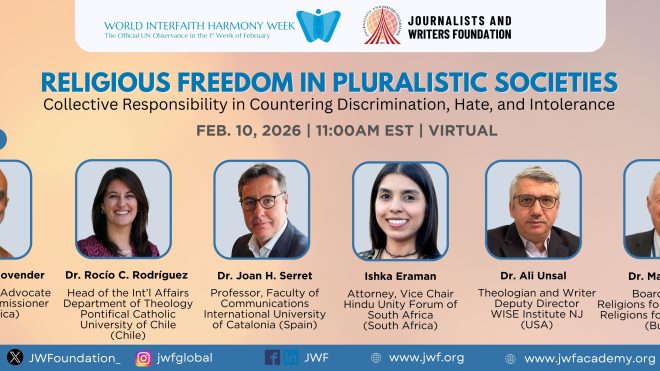
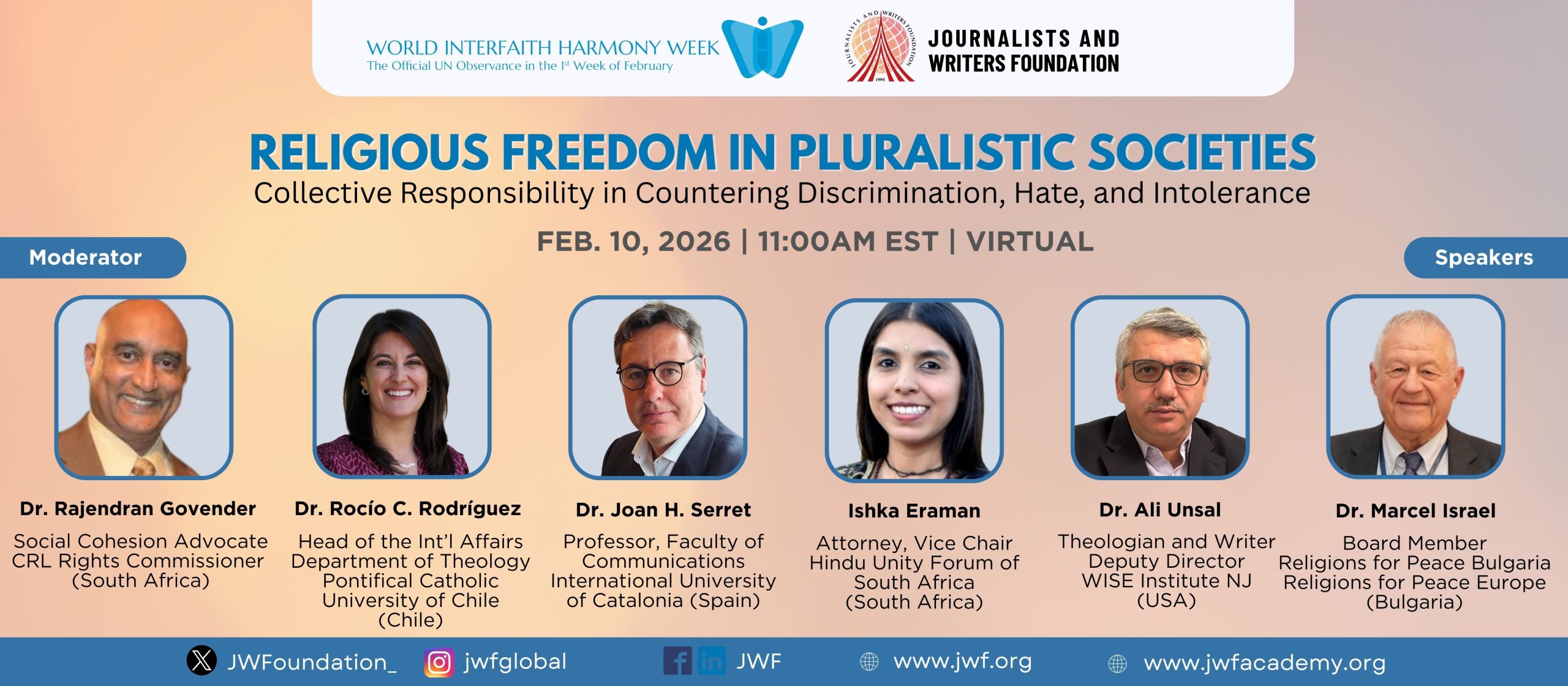
PANEL DISCUSSION
RELIGIOUS FREEDOM IN PLURALISTIC SOCIETIES
Collective Responsibility in Countering Discrimination, Hate, and Intolerance
February 10, 2026 | 11:00am EST | Virtual
In observance of World Interfaith Harmony Week, the Journalists and Writers Foundation convened an international panel discussion examining religious freedom in pluralistic societies. The event brought together scholars, interfaith practitioners, legal experts, and community leaders from multiple regions to engage in an interactive dialogue on collective responsibility in addressing discrimination, religious hatred, and intolerance.
The discussion focused on a broader global context marked by rising polarization, hatred, discrimination, exclusion from the society, including the instrumentalization of religious narratives in political and social discourse. Participants reflected on these growing concerns within their respective contexts, and also shared pathways forward that connect legal protections with social practice.
Opening Remarks
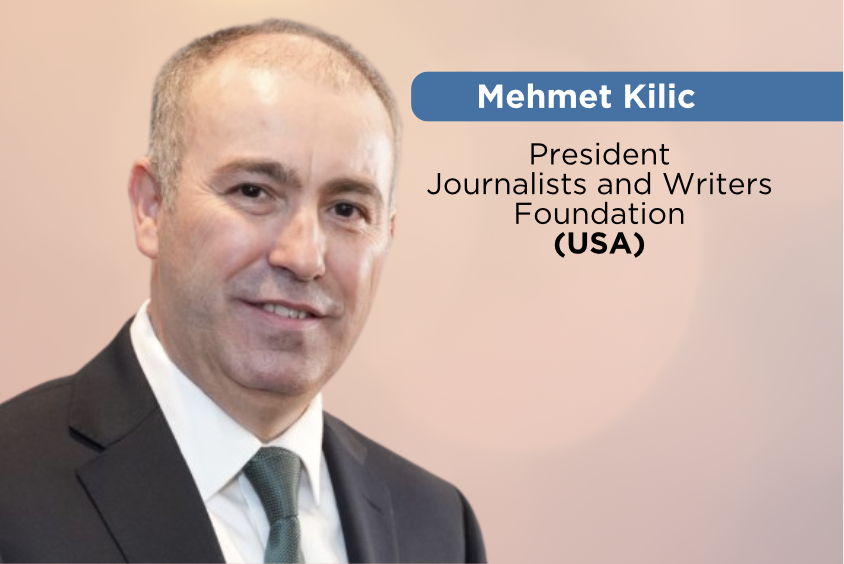 The panel discussed began with opening remarks by Mehmet Kilic, President of Journalists and Writers Foundation, who framed the event within the organization’s longstanding commitment to peacebuilding, human rights advocacy, and sustainable development. As an organization associated with the United Nations Department of Global Communications, Mr. Kilic emphasized the importance of creating secure platforms for constructive civil society engagement in global conversations on countering religious discrimination, hatred, and hostility.
A significant dimension of the panel was its policy recommendations on promoting and protecting religious freedoms worldwide. Mr. Kilic stated that the Journalists and Writers Foundation will compile the outcome of this discussion into a formal written submission to the Office of the High Commissioner of Human Rights’ Call for Inputs on “Countering religious hatred constituting incitement to discrimination, hostility, or violence.” Mr. Kilic invited the global audience to share their insights, experiences, recommendations and questions with the speakers that can help make a meaningful difference in countering religious hatred, preventing discrimination, and promoting human rights advocacy.
Introduction by the Moderator
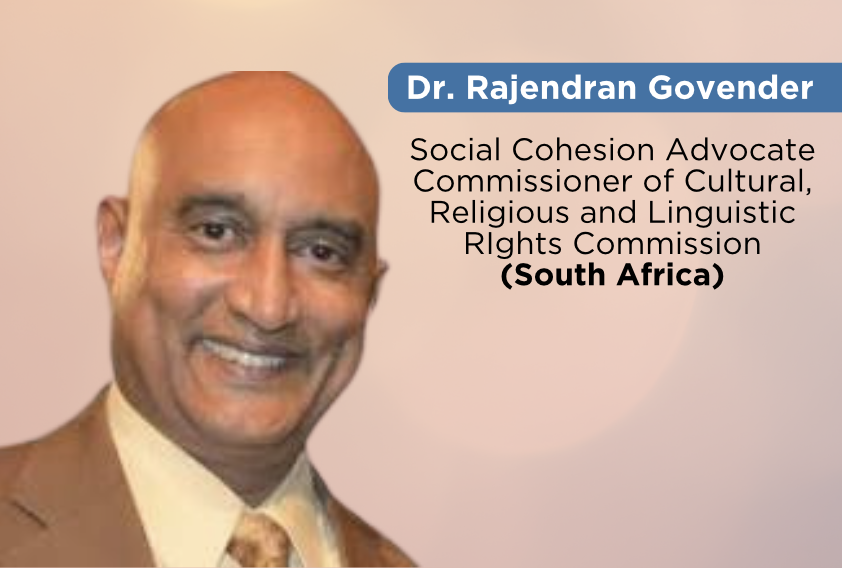 The panel was moderated by Dr. Rajendran Govender, a social anthropologist and advocate for social cohesion who serves within South Africa’s Commission for the Rights of Cultural, Religious and Linguistic Communities. In his introductory remarks, Dr. Govender underscored the interdependence between religious freedom and democratic resilience. He described religious freedom as a foundation for social cohesion, noting that its erosion often signals deeper fractures within the broader civic order.
Religious freedom, Dr. Govender observed, is most clearly understood when it is restricted. When marginalized communities experience exclusion from public life, when religious identity becomes grounds for suspicion, or when religious expression is selectively constrained, the consequences extend beyond individual rights and affect the stability of the wider social fabric. The panel was structured around opening reflections, moderated thematic questions, and concluding recommendations.
GLOBAL PERSPECTIVES ON RELIGIOUS FREEDOM
Religious Freedom Beyond Legal Formalism in Chile
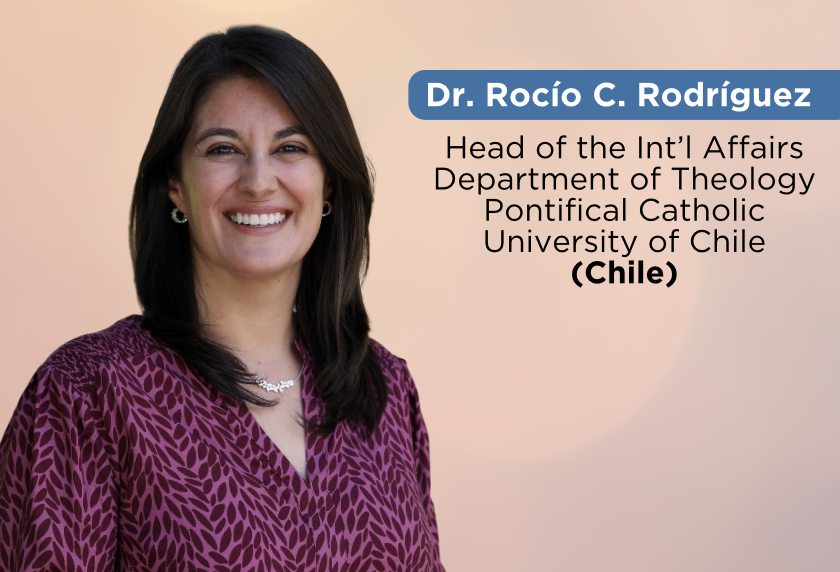 Dr. Rocío C. Rodríguez, Assistant Professor of Theology at the Pontifical Catholic University of Chile, emphasized that religious freedom must be understood not solely as a constitutional principle but as a lived social practice embedded within everyday interactions. While legal frameworks are indispensable for the protection of minority communities, she argued that legislation alone cannot eliminate prejudice, symbolic exclusion, or subtle forms of discrimination that emerge within schools, families, and civic spaces.
Drawing on Chile’s historical experience of church and state separation, Dr. Rodriguez highlighted the distinction between secular governance and the exclusion of religion from public life. Secular constitutional structures, she noted, can provide a neutral framework that allows diverse religious communities to contribute to the common good. However, discrimination often begins at a symbolic level through stereotyping, marginalization, or the practice of speaking about religious minorities rather than engaging with them directly. She also introduced the concept of intra-religious tensions, demonstrating that divisions may arise even within a single tradition when cultural or devotional expressions differ.
Education, Media, and Democratic Stability in Spain and Europe
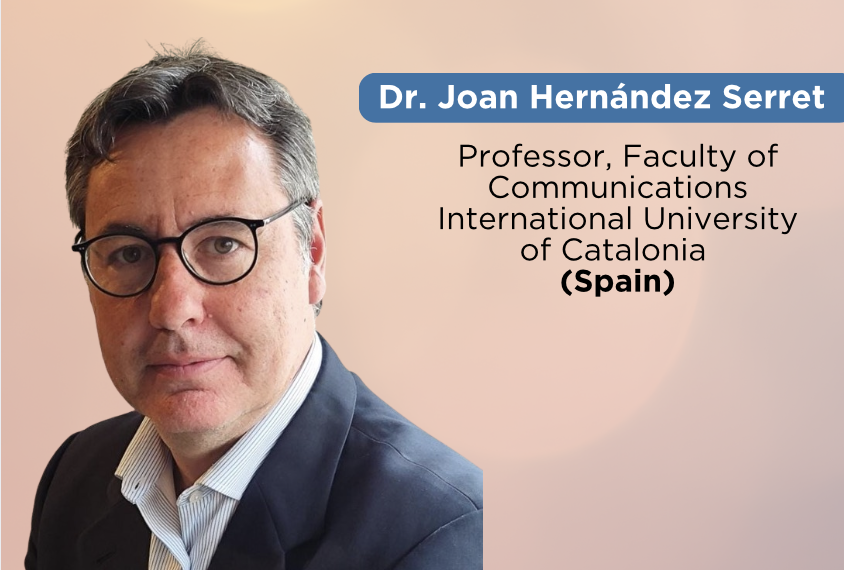 Dr. Joan Hernandez Serret reflected on religious freedom from the European context, describing a period marked by rapid social transformation, technological acceleration, and heightened uncertainty. In such conditions, religious freedom serves not only as an individual entitlement but as a stabilizing element of democratic life. He warned that when interreligious dialogue weakens, polarization intensifies and social trust deteriorates.
He emphasized the formative role of education systems in shaping perceptions of difference. Schools, he argued, are primary sites of socialization where children learn to navigate diversity. When religious literacy and inclusive engagement are integrated into educational practice, prejudice is less likely to crystallize into long term hostility. Professor Serret also addressed the ethical responsibilities of media institutions on religious freedom. In an era characterized by immediacy and brevity, complex realities are often simplified in ways that reinforce stereotypes. He called for greater care in distinguishing between verified information and opinion, amplifying diverse voices, and avoiding language that attributes collective guilt to entire communities.
Community Responsibility and Youth Formation in South Africa
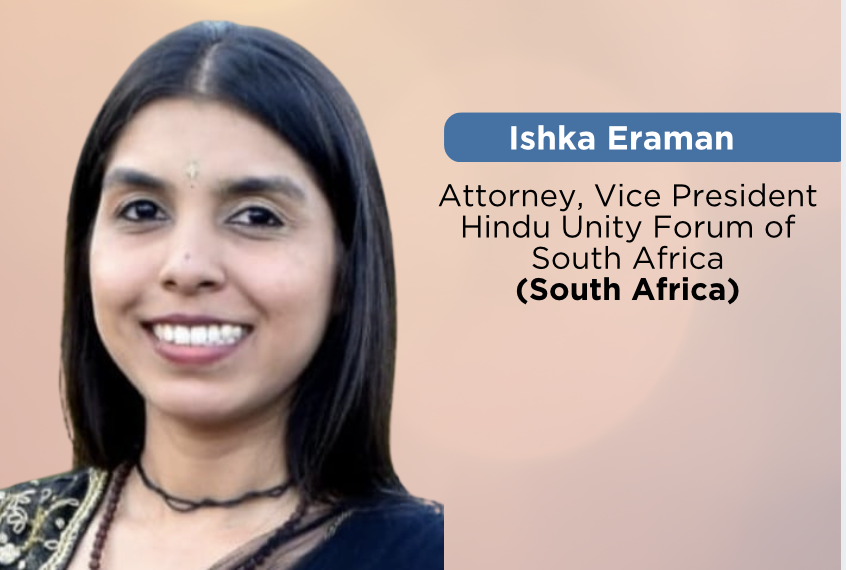 Ishka Eraman, an attorney and leader within the Hindu Unity Forum of South Africa, grounded her intervention in the South African constitutional context, where religious pluralism is formally protected. She argued that while constitutional guarantees are vital, the practical realization of religious freedom depends heavily on the conduct of individuals, faith institutions, and community leaders.
She highlighted the importance of youth engagement as a means of cultivating tolerance and empathy. Participation in faith-based service initiatives, leadership roles, and intercommunity activities fosters social responsibility and reduces ignorance. Religious education, she suggested, should not be narrowly confined to a single tradition but should provide broader exposure that equips young people to engage respectfully across differences.
Religious Intolerance, Selective Restriction and Legal Erosion in Turkey
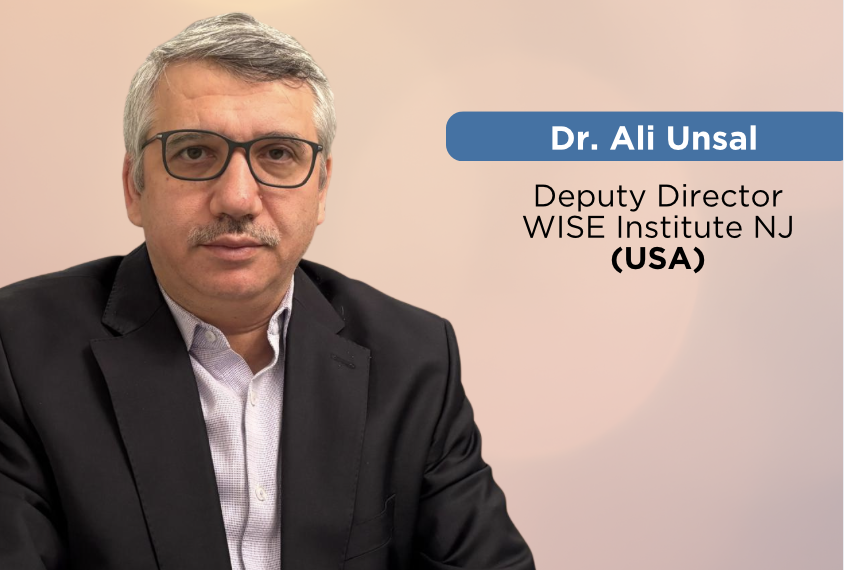 Dr. Ali Unsal addressed developments in Turkey following the failed coup attempt of July 15, 2016, presenting an analysis of how religious intolerance and selective restrictions on religious communities can undermine both religious freedom and the rule of law. He described processes through which religious texts and affiliations were treated as indicators of criminal intent, contributing to social exclusion and institutional marginalization.
Dr. Unsal shared the case of late Mr. Fethullah Gulen and the Hizmet Movement to illustrate how religious freedom can be transformed from a protected right into a mechanism of exclusion, punishment, and social fragmentation. He stated that in post-2016 Türkiye, restriction on religious freedom have not been applied in a general or neutral manner instead, it is selective, targeted, and discriminatory, aimed primarily at Hizmet-related individuals, ideas, and institutions, which contributed to polarization, social hostility, and a deep threat to social peace.
Dr. Unsal cautioned that when collective identity replaces individual accountability, and when public discourse adopts stigmatizing language, social cohesion deteriorates. The protection of religious freedom, he argued, requires consistent adherence to principles of due process, proportionality, and human dignity. The erosion of these principles has implications not only for specific communities but for democratic stability more broadly.
Institutionalized Interfaith Cooperation in Bulgaria and Europe
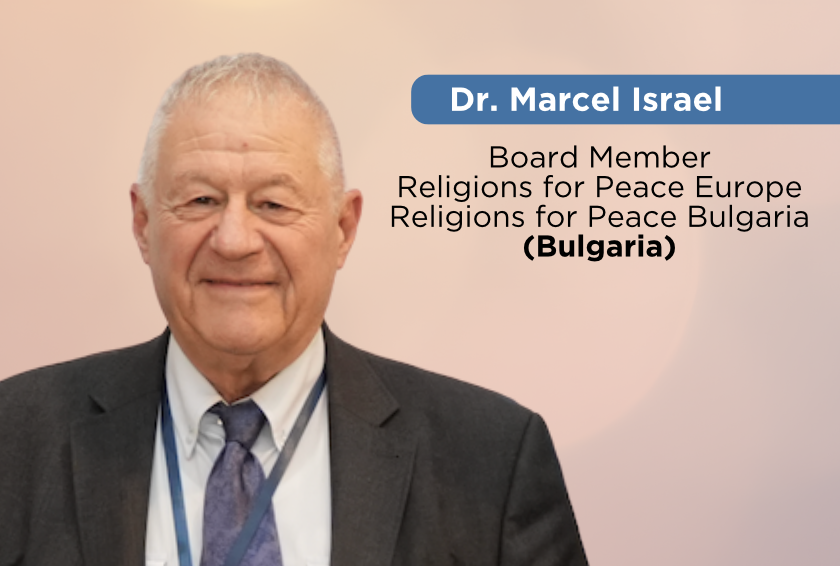 Dr. Marcel Israel provided insight into European interfaith initiatives, particularly through Religions for Peace Europe and the Bulgarian Forum for Interfaith Dialogue and Partnership. He described structured collaboration among faith communities, universities, ministries, and civil society organizations as essential to sustaining long term interreligious trust.
Dr. Isreal stated that Religions for Peace Europe is working and advocating intensively for Religious Freedom and against negative movements, like Islamophobia, Anti-Semitism, and hate against immigrants. To comply with this goal, they work with institutions, including the Senate of Berlin, different churches, universities in multiple countries, parliamentary groups, etc.
Such partnerships, he argued, institutionalize dialogue beyond symbolic gestures and create durable platforms for cooperation. Annual conferences, academic collaboration, and engagement with public institutions contribute to a culture in which religious diversity is managed through communication rather than confrontation.
Thematic Discussions on Religious Freedom
During the moderated discussion, several themes emerged with particular clarity.
First, the interpretation of sacred texts was identified as a critical sense of responsibility. Religious scholarship can either reinforce division through decontextualized readings or deepen understanding through historically informed and ethically grounded interpretation.
Second, education and media were repeatedly emphasized as formative institutions. Educational systems shape early perceptions of diversity, while media narratives influence public discourse. Both require sustained ethical commitment.
Third, youth initiatives and grassroots leadership were presented as practical mechanisms for translating abstract principles into lived practice.
Fourth, ethical leadership in religious contexts was framed as requiring consistency, disciplined language, and commitment to shared moral values such as dignity, justice, and compassion.
Fifth, institutional partnerships were identified as necessary for transforming dialogue into structural cooperation.
In their final remarks, panelists converged on a central conclusion. Religious freedom cannot be sustained through legal codification alone. It depends upon social conditions that enable respectful encounter, responsible communication, and institutional accountability.
The moderator concluded by noting that pluralistic societies resemble orchestral compositions in which multiple voices coexist without erasure. Harmony is achieved not through uniformity but through disciplined coordination grounded in shared principles.
The session closed with recognition of JWF’s ongoing initiatives, including youth engagement programs and sustainable development projects, reinforcing the organization’s commitment to linking dialogue with practical civic participation.
Speech Materials