
CSW70 PANEL DISCUSSION
Transforming the WPS Agenda from Resolution to Reality
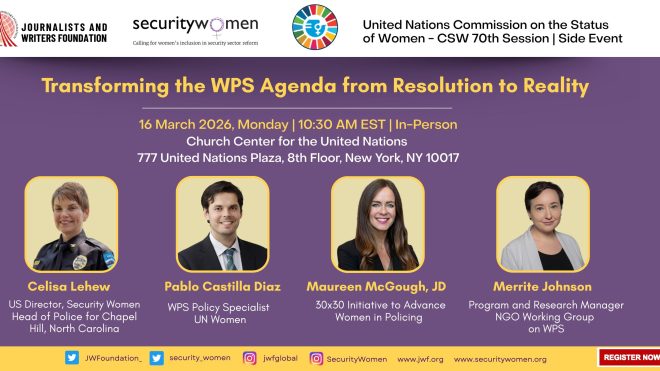
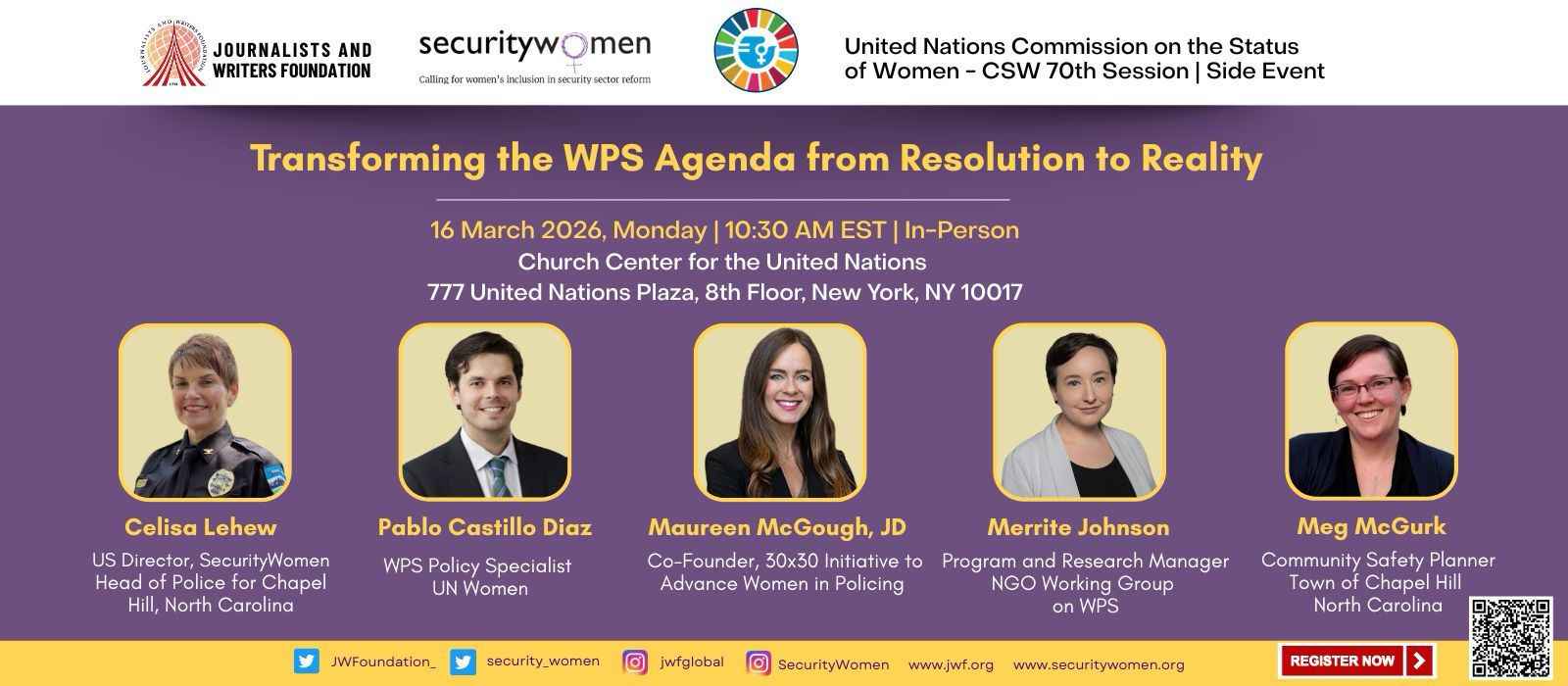
16 March 2026 | 10:30 AM EST | In-Person | Church Center of the United Nations, 8th Floor
RSVP for In-Person Participation | RSVP for Zoom
On the occasion of the UN Commission on the Status of Women, the Journalists and Writers Foundation and SecurityWomen co-organize a panel discussion, “Transforming the Women Peace and Security Agenda from Resolution to Reality”. This forum brings together researchers, women serving in security and defense sectors, and civil society representatives, to address contemporary challenges and accelerate the implementation of the Women, Peace and Security agenda (WPS).
The groundbreaking Resolution 1325 adopted by the UN Security Council in 2000, highlights the crucial role and leadership of women in diverse peacebuilding roles, including as uniformed personnel and peacekeepers, politicians, human rights defenders, and civil society leaders, and advocates for women’s active participation in rule of law, conflict prevention, mediation, transitional justice and peace processes.
WPS is not solely about the protection of women in conflict zones. It recognizes women as agents of change, architects and maintainers of peace, not merely the beneficiaries of peace. However, despite the progress in diplomatic realms and the transformative actions of local peacebuilding networks and post-conflict coalitions, disappointingly, the full and meaningful participation of women in security, defense and peacebuilding remains inconsistent and inadequate.
In the 25 years after its adoption, the WPS Agenda has fostered historic achievements, empowering women`s leadership in the peace and security arena on a global scale. As of today, over 110 Member States have adopted a National Action Plan (NAP); some NAPs include concrete targets and quotas to increase women’s representation in security and justice sectors.
According to the UN Secretary-General`s WPS 2025 Report, the availability of sex-disaggregated data for the evaluation of the Sustainable Development Goals` progress increased to 63% from 26% over the last decade. While impunity for crimes perpetrated against women and girls in conflict areas remains widespread, international tribunals and judiciaries are harnessing existing legal frameworks to work to end impunity against rape as a war crime. The Elsie Initiative for Women in Peacekeeping Operations funds research opportunities that elevate the status of women in uniformed roles and assist Member States to remove barriers that prevent women’s participation in policing and the armed forces. In October 2024, the UN Secretary-General launched a “Common Pledge to Increase Women’s Full, Equal and Meaningful Participation in Peace Processes” thereby mobilizing mediation actors from Member States and intergovernmental organizations.
Globally, women`s participation in major peace processes in 2024 reached 20% as signatories, 14% as mediators and a mere 7% of negotiators (nearly 9 out of 10 negotiation tracks included no women negotiators at all).3 It is stated that over 676 million women and girls are located within 50 kilometres of an active conflict, which is the highest recorded increase in societal violence since the 1990s4, which inevitably and disproportionally impacts women and girls. Many additional root causes keep the WPS objectives illusive including, but not limited to, the historic rise of armed conflict, the changing landscape of conflict, global financial crises, abuse of rule of law, authoritarian regimes’ control over public discourse, shrinking space for civil society, and unconstrained artificial intelligence.
Speakers

Celisa Lehew (Moderator)
US Director of Security Women, Head of Police for Chapel Hill, North Carolina

Pablo Castilla Diaz
WPS Policy Specialist
UN Women
 Maureen McGough, JD
30×30 Initiative to Advance
Women in Policing
 Merrite Johnson
Program and Research Manager, NGO Working Group on WPS
 Meg McGurk
Community Safety Planner Town of Chapel Hill North Carolina
Topics for Discussion
- Best practices pioneered by Member States within National Action Plans that drive progress toward gender equity, gender parity, and peace.
- The status of women in the security and defense sectors and barriers to women`s recruitment in security and defense institutions.
- Strategies to address patriarchy, confront gender stereotypes and challenge patriarchal narratives that shape societal norms.
- The gap of political will and the need to implement the WPS agenda. Avenues for civil society actors and policy makers to influence high-level decision makers to initiate and follow through on policies.
- Heightened forms of violence targeting women in political leadership positions and in civil society, particularly in states where authoritarian governance is on the rise.
Date: 16 March 2026, Monday
Time: 10:30 AM – 12:00 PM EST
Venue: Church Center for the UN, 8th Floor
Organizers:
- Journalists and Writers Foundation | www.jwf.org
- SecurityWomen | www.securitywomen.org